By: Miguel Molina
HISTORICAL ANTECEDENTS: THE RISE OF THE SOVIET UNION
While the 19th Century was fundamental for the modernization of the great European economies, Russia continued depending on agrarian economy and feudal relations of vassalage between lords and peasants. The social Russian structure was pyramidal with the Czar on the top, always ignoring people’s situation that in most cases were in poverty. During that time Karl Marx and Frederic Engels, considering the social inequality and power abuses, started to build a new political, social and economical system based on the proletariat capacity and rule. The Communist Manifesto, a book written by Marx and Engels, and the Capital written only by Marx, inspired many political and social movements in Europe.
This ideological doctrine was denominated at first Marxism, and it consisted of the destruction of private property and religion, because both were instruments used by the bourgeoisie to alienate the proletariat. Marx explained his proposals saying that the changes of human society are produced by the eternal fight of classes, but the modification of this relation results in evolutionary steps; he called this process Historical Materialism. For Marx the history of humanity is based on 5 parts: the primitive communism, oriental despotism, slavery, feudalism and capitalism. The next evolutionary step would be the socialism that had to overthrow the capitalism with the Proletarian Revolution. Marx said that it was “historically unavoidable”.
In Russia the unsustainable social situation made people organize a popular protest in front of the Winter Palace of Saint Petersburg; they wanted better labor conditions. Czar Nicolas II, afraid of the thousands of workers congregated in the protest, ordered to open fire against the people. Many people died because of the military repression. After this a lot of revolutionary movements started to conspire against the monarchy. The Czar established some reforms as gave more legislative power to the Duma (Parliament) and let the universal vote to recover the national stability. But the light of the revolution was burned.
In 1917 a new revolutionary movement began in Russia guided by the Bolsheviks, a group of workers who wanted an absolute revolution of the Proletariat that included the spread of blood. The Czar ordered the Army to end the revolutionary groups but the unhappiness of the soldiers resulted in divisions inside the army, so part of them decided to help the revolutionary cause. This situation forced the Czar to resign and a civil war was started in the country. In 1918 the Royal Family was killed, in 1921 the White Army (loyal to the Czar) was defeated and in 1922 the Union of Soviet Socialist Republics was born.
ECONOMICAL GAP BETWEEN WESTERN AND EASTER EUROPE
Vladimir Lenin was the first leader of the new nation and of the Communist Party; he also was the most important leader during the Revolution. After his death Stalin took power and began an era of repression persecutions of his opponents. His management of the economy consisted of Quinquennial Plans for which the capital obtained by the industry was invested in other industries that helped to modernize the armament and the army, instead of providing for the Russian society.
During the Second World War Stalin defended his territory using the cold climate as his best ally to destroy the German invaders. When Hitler was defeated Stalin decide to took the control of the countries located to the east of Berlin, so he transformed them in communist nations which were satellites of the Soviet Union.
After the Second World War the international hegemony was divided into two big blocs. One formed with occidental countries that were liberal, democratic and with capitalist economies led by the United States; and a bloc formed with the communist countries of Europe, Asia and Africa led by the Soviet Union.
The contrast between the Free Market Economy of the western countries and the socialist economies conducted by the State was evident. The western societies were developed by industries and businesses, and their people had a good standard of living, they get jobs, housing and all things that their work can give to them, creating a society of consumers and producers. On the other hand, the communist countries had no private investment; the state owned all the means of production, there was no freedom of expression and the citizens lived in bad conditions because the government preferred to spend money on the army and not on the people. As it was not possible for individuals to invest the communist countries didn’t benefit from private initiative therefore the supply of goods was very limited which resulted in a very low standard of living in comparison to the west. Consequently, many people in the eastern economies wanted to flee to the west which by the end of the 80’s became unstoppable.
THE COLD WAR AND THE FALL OF COMMUNISM
By the year 1949 the United States signed with some democratic countries the creation of the North Atlantic Treaty Organization (OTAN) to defend themselves from a Soviet attack and 6 years later the Soviet Union signed a treaty called the Warsaw Pact with the communist countries of Eastern Europe (except Yugoslavia) and China as an important observatory country. This was the beginning of a situation of tense international calm denominated Cold War.
The Cold War was an ideological and military conflict between the United States and the Soviet Union but without a direct confrontation. A popular phrase explained that condition: “Peace impossible, war improbable. Anyway the two powerful nations tried to prove their superiority in conflicts as the Korean War and later the Vietnam War, both became a confrontation between communism and capitalism. They also used their influence in Cambodia, Mozambique, Angola, Cuba, Chile and Nicaragua.
The competition between the two hegemonies was centered on armament and technology. The Soviet Union promoted the nuclear armament and the creation of strong missiles for an eventual attack to the west in a hypothetical North American attack. The worst tense moment took place when the United States tried to stop the communist dictatorship in Cuba with the unsuccessful attempt of invasion in the Bahia of Cochinos that provoked a Soviet reaction with the deployment of nuclear missiles in Cuba with the sufficient reach to the US coast. This tension was denominated the Missiles’ Crisis and it ended with an agreement between Kennedy and Khrushchev in which the Soviet Union removed the missiles meanwhile the United Stated compromised to not invade Cuba.
The armament competition came to an irrational level which meant that in the end of the 80’s the two hegemonies had the sufficient nuclear power to destroy the Earth a lot of times, so the two regimes knew that their destruction was sure in an eventual war. The end of this competition and the first steps to the end of the communism was the Strategic Defense Initiative of the United States that consisted of an umbrella or network of protection against Soviet missiles. The Soviet Union tried to do the same but for those years their economy was in crisis; they could not take care of the basic needs of the population, and they had to accept their impossibility to continue competing with the United States.
The collapse of the Communist system started and was unavoidable. Mijail Gorvachov took the power of the Soviet Union in 1985 and he promoted two important decisions to finish to Cold War because it was unsustainable, and also to modernize the Soviet Union. The first one was Glasnot that consisted of transparency in political decisions and giving more freedom to the society. The second and the most important measure was the Perestroika which consisted of economic reforms that allowed private investment and property, and opened the country’s economy.
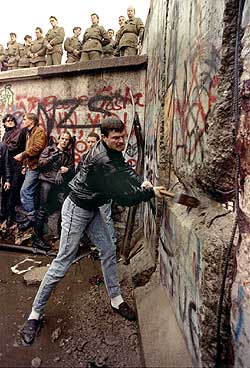
In 1989 the Berlin Wall which divided East and West Berlin and was the symbol of the division between communism and capitalism, was torn down. As a matter of fact, at that time it was impossible to stop the avalanche of people fleeing from the east to the west, therefore the communist society was not sustainable anymore and collapsed. In 1991 Mijail Gorbashchov dissolved the Soviet Union and freed the satellite countries, so the era of communism came to an end.
VALUE: LOYALTY
After the fall of the communism and the disintegration of the Soviet Union some people thought that that was the beginning of the capitalist era for the whole world. But what is important to say is that the left side of politics learned about their own mistakes during the Soviet Union and communism, and they organized themselves again to participate in politics putting aside the old socialist ideas in which democracy was used as an instrument. The loyalty consists in continuing to believe in socialism still today but thinking in democracy with a deep conviction and as a principle of life, the way it has happened in Europe. The new socialist European parties defend their ideas but they don’t agree with the use of violence and armed fight. The best lesson about the fall of communism is to understand that it is possible to be socialist without thinking that the Soviet Union is a good example of a good society and also to accept that to have another alternative to capitalism is healthy for democracy. No one owns the truth.
PERSONAL OPINION
In my opinion the fall of communism was an important historical episode to learn about the right and wrong economical and political methods that complement a system. I don’t think that the left is a defeated political project; some of their forms failed as the communism used in the Soviet Union, but the search of social justice and equality is stronger than ever before and what capitalism and socialism have to do is to not repeat the great historical mistakes of the past. The purpose doesn’t justify the means as Nicolas Machiavelli said, because if we use anti democratic methods, we already condemn the purpose. The leaders of the Soviet Union made a divorce between the ideas of welfare for their society and the regime of terror and repression that they created. They didn’t keep individuals as the center of their purpose because in what they invest the major part of their time was in the armament competition against the United Stated. The communism didn’t lose the war against capitalism, they defeated themselves with an irresponsible management of the economy, using anti democratic methods and creating a society of fear and panic where freedom didn’t exist.