Mostrando entradas con la etiqueta ecuadorian. Mostrar todas las entradas

18 jul 2009

ADOLESCENCE IN THE ECUADORIAN SOCIETY


By Miguel Molina Díaz

Ecuador is a youth country considering that 60% of the population is under 28 years. The adolescents in the Ecuadorian society are a diverse group of people that express themselves in a lot of different ways. Depending on the social status, education opportunities, familiar formation and the location where they live, teenagers’ personality and characters can vary a lot. The social status can determine the way of thinking of a teen, for example we can find young people that are only interested in consuming and others that want to preserve the ecosystem. Education is an important factor because in our country a lot of children and teens don´t have access to this basic right as a consequence of poverty, so many of them mature early, being exposed to risky behaviors that include the use of drugs among many other dangers. Every factor is related to each other. If we talk about familiar formation we can assume that not all the families in Ecuador are functional, which means that a lot of teenagers grow in atmospheres that include violence, the use of alcohol and the lack of a father figure. Some adolescents grow without their parents because of migration. According to statistics, the location is a factor that has a great influence in the situation of a teenager because the reality of rural zones and urban zones are not the same.

Of course, the above mentioned factors are not necessarily definitive, but they give us an idea of how teenagers develop in society. At this time, the young people are the most diverse group in the society, and some of their expressions are influenced by factors as music. In Quito alone, we can have a lot of urban cultures that interact following gender postulates and principles that prevail in rock, punk or metal. In the last years a group of teenagers denominated EMOS appeared, whose name relates to the word emotion. They wear a very original fashion using shadow colors and a strange hair style. This group of people thinks that the way in which they can give sense to their lives is through suffering and pain, for that reason they have a big opposition in the society. There is another group called skin-heads that are a group of young people influenced by Nazis ideas and believe in the social cleansing, so they use violence and abuse to show the supremacy of their race. These two groups are part of a minority but the majority of the adolescents in Ecuador are good people who dream as any person.

In my opinion the role of teenagers in society gets bigger and bigger with time because we assume bigger responsibilities in a society that each day is more difficult to us in a lot of aspects. We are in the middle of a lot of danger as the AIDS infection, and we are the only ones that can take care about our own lives. The Constitutional Assembly approved the optional vote for teens between 16 an 17 years, and that is for me an opportunity to show our own capacity and decision-making ability to built better days for our country. We can´t wait for other people to make the changes that we need and this is a good way to involve teenagers with Ecuador, our country. Something important to mention is that the conservative Ecuadorian society conceptualizes the teens as unreliable people, and this stigmatization and prejudice became so strong that a lot of adolescents think the same as the establishment. That is something that we have to avoid as a society in order to promote the participation of adolescents.

miguelmolinad@gmail.com

11 mar 2009

THE DIVISION OF THE POWER


By: Miguel Molina Díaz

HISTORICAL ANTECEDENTS: THE ABSOLUTISM

At the end of the Middle Ages, feudalism, as a social and political system, was replaced by a new form of government denominated absolutism, which is a sovereign monarchy without limits and control, that recognize to the subjects just the duty to obey. This historical moment in which the European monarchies use this form of government lasted from the 16th century to the 18th century. The theories of the Middle Ages related to the Mandate of Heaven assume that God gives the right to rule to the Church and to the institutions headed by the king. With the appearance of the Protestant Reform the Roman Catholic Church lost their political influence in Europe; this resulted in the strengthening of monarchies who concentrated the power. Other factor that favored absolutism was the growing national identity as a consequence of wars.

The central government became strong in the European countries and their territorial limits were determined with precision. Nicolas Machiavelli said that the ideal prince or ruler had to establish his absolute power to avoid political corruption and dissensions inside the state. For that purpose he suggested to use any means including violence. So absolutism recovered the power related to the church and politics in one person’s hand.

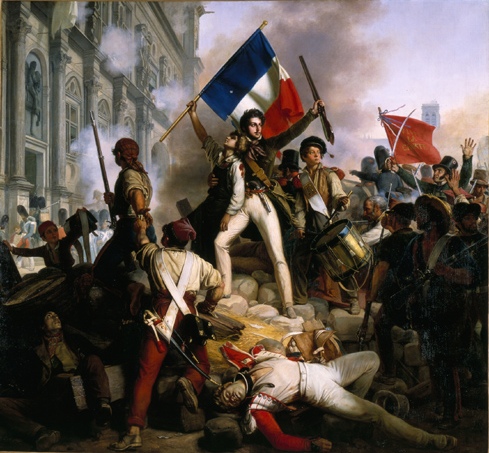
France was the best example of absolutism during the 17th and 18th centuries. Louis XIV, one of the most tyrannical rulers said: “I am the State” justifying his despotism and the unlimited use of his power. In the second part of the 18th century another French ruler, Louis XVI, applied financial reforms that were not successful in maintaining the economical stability for the lower class which couldn´t satisfy their basic needs. Meanwhile the royal family squandered the budget in their luxuries and opulent obsessions. This historical event marked the beginning of the French Revolution which was the first step of the Illustration in order to accomplish liberal democracy and the principle of the division of powers.

THE TREE BRANCHES IN THE MODERN STATE: LIBERALISM AND ILLUSTRATION

John Locke was the first philosopher who thought in liberal ideas as the necessity to divide the total and absolute power. Some years later the French political thinker and also philosopher Charles Baron de Montesquieu created the political theory about the separation of powers and that was an argument used by the French revolutionaries. Montesquieu considered that the main threat to freedom was the power, but as the latter was indispensable to prevent society from falling into anarchist, his solution was to divide it in three great pieces: The Legislative Power, in charge of creating the laws and the juridical framework of the nation; the Executive Power, in charge of administering the State under those laws and that juridical framework; and the Judicial Power, which was responsible for the administration of justice. This all resulted in a balance of powers and a system of brakes and counterweights where power limits power, so people’s liberties were protected. These powers or branches had to be independent from each other so one branch can’t interfere with another. The principle of the separation of powers and the right of the free determination of the people were the two great advantages of the Illustration. Jean Jacques Rousseau complemented this theory saying that the rules and standards have to come from the sovereign will of the people as a Social Pact, so the sovereignty belongs to the citizens.

This political theory was adopted at first by the North American constitutionalists. They established in their Constitution, which was the first one in the world, the three institutions that take on each of the three branches. They gave the legislative power to a Congress composed by two chambers or houses that write, discourse and vote the laws; the executive power was given to the President as the head of the government and the state, he is elected by the people for 4 years; and the Judicial Power was in charge of the Supreme Court as the head of the judicial system, this is a mechanism for the resolution of disputes.

The civilized world adopted the principle of the division of powers in their constitutions as the United States and that separation became the most important part of the liberal democracy. Today the majority of the countries have followed this principle of the Modern State to guaranty the peoples’ rights and freedom, and to avoid abuses of power. There are states where their political systems are called parliamentarian, presidential, or parliamentarian monarchy. These three types of states’ systems have their three branches divided from each other and the principle works correctly. The legislative branch can have one house or two houses. The first one has a parliament with just one house and the second one is made of two houses such as Senate and the House of Representatives, or Lords and Commons as in United Kingdom. Depending on the fact that the state is presidential or parliamentarian the executive branch can be in charge of the President or Prime Minister, the one who is the head of the government.

In Ecuador, after the last constitutional change, the legislative power has the National Assembly formed by 124 members; the executive power has the President of the Republic as the head of the National Government which also is formed by the vice-president, ministers and secretaries; and the judicial power is under the responsibility of the National Court of Justice and the National Council of the Judicature. In order to give more equilibrium and balance to the system, the Constitutional Assembly created two other powers that also have to be independent from each other. The first one is the Electoral Function in charge of guaranteeing the transparence of all the electoral processes, making sure that people’s intention is respected. And the last one is the Function of Transparency and Social Control which is in charge of running the Organisms of Control such as the Superintendences, and selects the best people to form these organisms.